The engineering behind our wind turbine - and the story of how NC State's team came together to build it.
For the Collegiate Wind Competition, teams design a small-scale turbine that has to start up, produce power, and survive a controlled wind-tunnel test - all while meeting strict safety rules. Every subsystem below is designed, built, and tested by students.
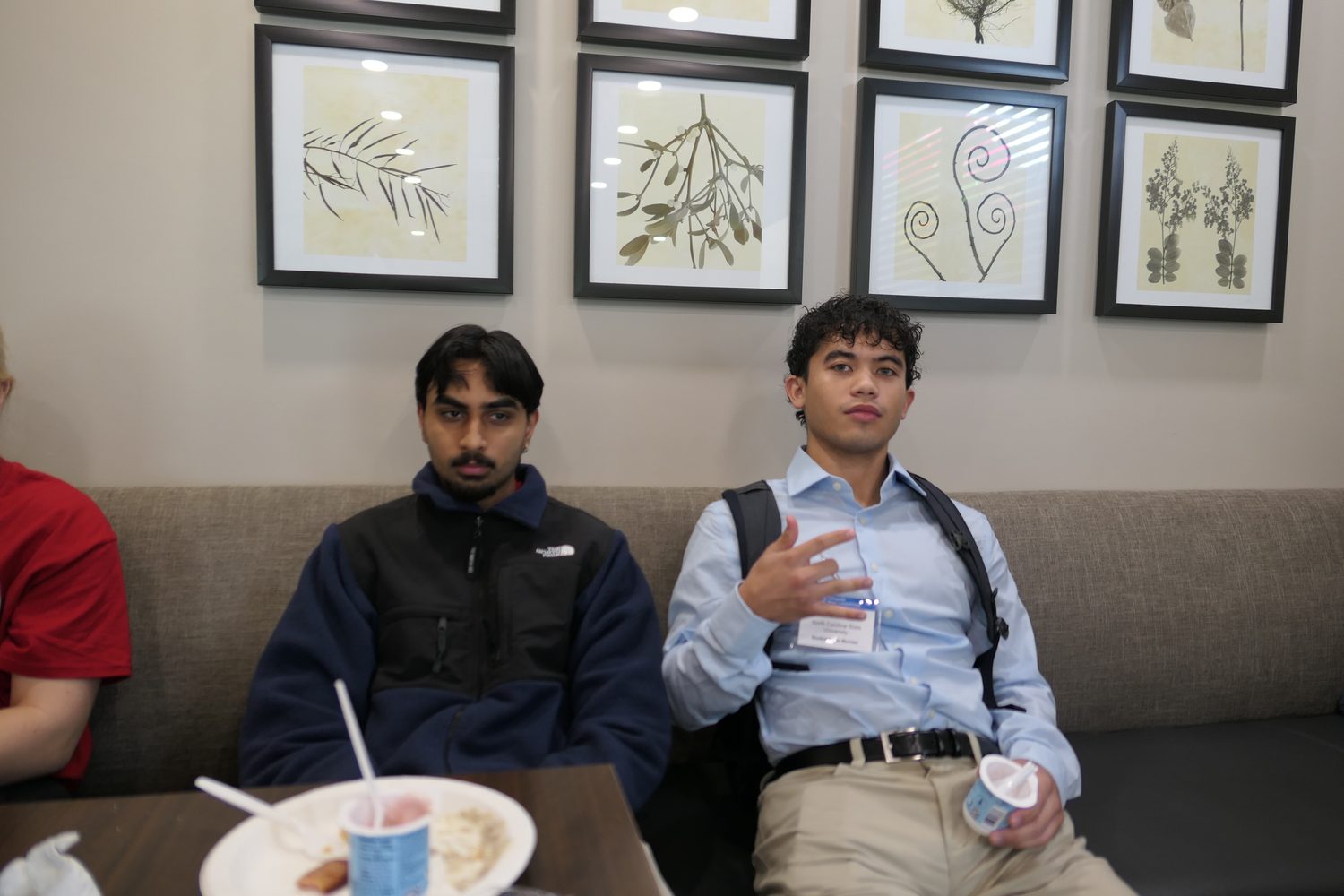
Our turbine starts as sketches and CAD, moves through prototyping and bench testing, and ends in the wind tunnel. Along the way, the Mechanical, Electrical, and Project Development teams iterate together - trading data, fixing what breaks, and tightening the design for competition.
Every competition cycle we rebuild the turbine around what the last one taught us. Pick a year to see the machine, its specifications, and how it performed.
A 45 cm horizontal-axis turbine designed and built from a clean sheet in a single semester, around three principles: modularity, simplicity, and reusability. Three 3D-printed ABS blades on an A18 airfoil drive a direct-coupled D6374 brushless generator, with active collective pitch and a fail-safe three-phase short-circuit brake.
The brake is a hardware fail-safe: it needs a constant HIGH signal to stay disengaged, so losing controller power or a broken wire drops the line LOW and shorts all three generator phases automatically, with no software in the loop.
Our 2027 machine is in design now, built directly on what the first one taught us. We are publishing the targets below as they are locked in, then the as-built numbers once it is on the test stand.
Want to help decide what goes in these boxes? The design is open and we are recruiting. Join the Pack.
The 2027 design report and technical inspection will be posted here once the season wraps up.
We're a young team with big momentum. Here's the story so far.
A group of NC State students forms a team to enter the Collegiate Wind Competition, uniting engineering and project development under one mission.
Mechanical, Electrical, and Project Development teams come together, recruiting members from across majors and starting on the first turbine designs and project plan.
The team prototypes, builds, and bench-tests the turbine while the Project Development team prepares the siting analysis and business case for the competition deliverables.
Windpack travels to compete on the national stage - presenting to judges, running the turbine, and representing NC State in our debut appearance.
We're applying everything we learned, growing the team, and engineering an even stronger turbine for the next competition. Want in? Join the Pack.
Dig into the competition we build for, or come help design the next turbine.